Yorkshire
A Woman of SubstanceYorkshire is the novel’s landscape of belonging and industrial power: the place where Emma Harte’s roots endure, where the wealth of the Fairley family is built on workers’ labor, and where Emma establishes the businesses that become the foundation of her success. Its moors, weather, and textile geography shape personal memory as insistently as its mills and cities shape economic life.
Geography and textile foundations
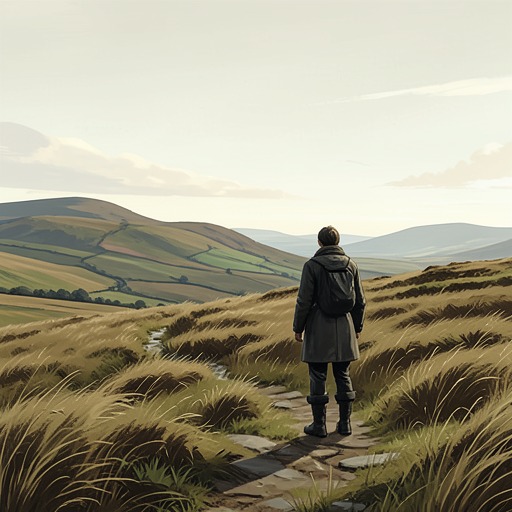
Fairley village lies in the foothills of the Pennine Chain, a range described as the backbone of England. The region’s geology helps explain why textile production takes root there. In northern Yorkshire, white limestone hills support sweet grass, but the scarcity of springs and the hardness of limestone water make it harsh on fibres. Farther south, beyond the Aire Gap near Skipton, the West Riding is formed of millstone grit, with coal measures and coverings of peat or clay. The land yields little beyond oats and coarse grass, yet its short-haired sheep thrive on that grazing.
The same landscape supplies the water and raw material essential to clothmaking. Streams run reliably through coal and grit country, fed by moisture-laden winds from the Atlantic; unlike limestone water, their soft water is kind to fibres. Sheep’s wool and soft water are both plentiful in the West Riding, making the region’s physical character a direct foundation for its woollen industry. Yorkshire’s mills are not incidental scenery: they belong to an economy made possible by the conjunction of terrain, climate, livestock, and water.
Leeds extends that regional economy into a powerful industrial city. Emma sees it as grey and brooding, but also rich with energy: a centre of clothing factories, woollen mills, iron foundries, engineering firms, cement works, and printing plants. The city is at once her home ground and the seat of her influence. Its commercial scale is visible in the factories and buildings she owns, and in the department store bearing her name.
A landscape of belonging and estrangement
Yorkshire’s emotional meaning is clearest in Emma’s response to returning. A glimpse of blue sky from a private aircraft recalls the clear spring sky of a Turner painting above the parlour fireplace at Pennistone Royal. The image makes a distant view intimate: the sky belongs to a remembered Yorkshire day when the wind has swept fog from the moors. Emma knows she is back in Yorkshire before she reaches the house; she experiences the recognition as something rooted in her bones, a sense that this is the place where she belongs.
Her arrival at Pennistone Royal gives that inward recognition a physical setting. The March wind comes down from the moors, while daffodils ripple in the grounds and damp earth and peat-scented growth announce spring after winter. The cold and penetrating air contrasts with the sunlit gardens and the green lawns descending towards the lily pond. Yorkshire’s weather is not a stable pastoral backdrop: it can make the landscape feel welcoming, severe, or threatening, sometimes within the same season.
For Adele Fairley, the moors carry the opposite meaning from the one they hold for Emma. During a violent downpour, the hills appear as sombre, immovable forms beyond the storm-lashed house. Adele, whose native Sussex has accustomed her to a gentler green landscape, sees the moors as a wall enclosing both the house and village. The same regional landscape that gives Emma a powerful sense of home intensifies Adele’s feeling of being an outsider.
The moors also change dramatically with the year. At the end of August, heather spreads across the hills in waves of purple and magenta, briefly transforming their usual dark, dun-coloured appearance. On a hot August morning Emma crosses a green meadow speckled with daisies and looks towards hills shaded lilac and purple beneath a cloudless sky. Such seasonal reversals make the landscape more than a fixed emblem of hardship: it holds austerity and sudden beauty together.
Class, labor, and the Fairley estate
Yorkshire’s social geography is sharply divided. Working at Fairley Hall, Emma observes the gulf between the Fairleys’ luxurious, sheltered life and the village workers’ harsh existence. The family’s comfort depends on their labor, yet the people whose toil finances that comfort remain separated from its consequences. The contrast gives Emma an early understanding of how privilege is sustained locally, within the same landscape that contains both the estate and the village.
The division has a commercial as well as a domestic face. The Fairleys control their mills and the fortune attached to them, while Emma studies their holdings and business affairs with patience and secrecy. She identifies competition in business as a means of striking at the family and has already made it difficult for them to replace workers she recruits away from Thompson’s mill. Her campaign is therefore grounded in Yorkshire’s actual industrial structure: control of labor and production becomes a route to power over the families who own the mills.
The conflict persists even as Emma builds an independent life. Her interest in the Fairleys does not fade when her other responsibilities grow. After Gerald Fairley is ruined in 1923, he depends on Edwin Fairley for support; Gerald dies in 1926. Edwin, meanwhile, becomes a prominent criminal lawyer and retains an important connection to Leeds through the Yorkshire Morning Gazette, where he serves as chairman and majority shareholder. The region remains the setting in which family history, public influence, and commercial rivalry overlap.
Emma’s businesses and Yorkshire’s wartime economy
Emma’s attachment to Yorkshire coexists with her command of its business. She periodically returns to Leeds from London and oversees the northern shops and mills through Winston Harte, who manages them. These journeys and arrangements preserve the region as an active part of her enterprise rather than a childhood memory. Her businesses operate within a wider economy exposed to national and international shocks: she studies financial reports on the crisis, including the closure of the London Stock Exchange and the increase in the bank rate from 4 per cent to 8 per cent, as signs of mounting danger.
During the war, the Yorkshire businesses demonstrate how quickly production can be reorganized. Harte’s department store continues to hold its position despite reduced trade; Emma carefully allocates the stock stored at Gregson Warehouse and finds new supply sources. Under Ben Andrews’s management, Layton’s mill meets large government contracts promptly. Emma and David Kallinski suspend the Lady Hamilton Clothes line at the war’s outset and redirect the factory’s entire production to uniforms. The regional textile capacity described in the account of the Pennines thus becomes part of the country’s wartime supply effort.
The newspaper trade offers another means of extending Emma’s influence in the North. Edwin’s position at the Yorkshire Morning Gazette makes the paper a point of contact between his career and the family’s commercial conflict. Emma considers buying the Yorkshire Morning Observer as well, envisioning a foothold in northern publishing and a source of competition for Edwin. The Yorkshire Consolidated Newspaper Company later takes control of the Gazette, a victory that Blackie O’Neill recognizes as a decisive success for Emma. She retains authority over editorial policy even while allowing Jim Fairley substantial power to run the papers.
Narrative significance
Yorkshire joins place, labor, memory, and inheritance. The region’s geology helps account for its textile wealth; its social divisions expose the human cost behind the Fairley fortune; and its industrial network gives Emma the means to contest that fortune. Leeds provides the commercial centre from which she builds and directs her power, while the moors and Pennistone Royal preserve a more intimate connection to home.
That combination prevents the setting from being reduced either to a pastoral refuge or to an industrial backdrop. Yorkshire can be a place of rootedness for Emma and confinement for Adele, a landscape of heather and spring light as well as one of hard work and stark inequality. Across changes in the family and the business, Emma’s return to the region repeatedly brings her personal origins into contact with the economic empire she has made there.